

How to Build a Company Operating System with AI
Most owners were trained to run a company on meetings, spreadsheets, and gut feel. So was I. Here's how I'm rebuilding two companies to run on a system instead.
Craig Cecilio · The Relentless Builder
A company operating system with AI is the set of rules, data, and routines that runs your business when you're not in the room, with AI doing the watching, sorting, and first drafts. Most owners have never seen one built.
I was trained the old-school way: hire good people, hold the weekly meeting, check the numbers on Friday, and fix whatever breaks. That playbook worked for 30 years, but I'm now building two companies at the same time, and it would bury me in a month. So I'm building the operating system first, and here's exactly how I'm doing it.
Why the old way breaks
In the old model, the owner is the operating system. Every decision routes through you. Every problem waits for your meeting.
That's fine at 10 people. At 50, you're the bottleneck. At two companies, you're the outage.
AI doesn't fix that on its own. I've written that AI breaks companies that aren't ready, and I meant it. Bolt AI onto a messy company and you just get the mess faster.
The five layers of a company operating system
Here's the stack I'm using. Build it in this order. Skip a layer and the layers above it fall over.
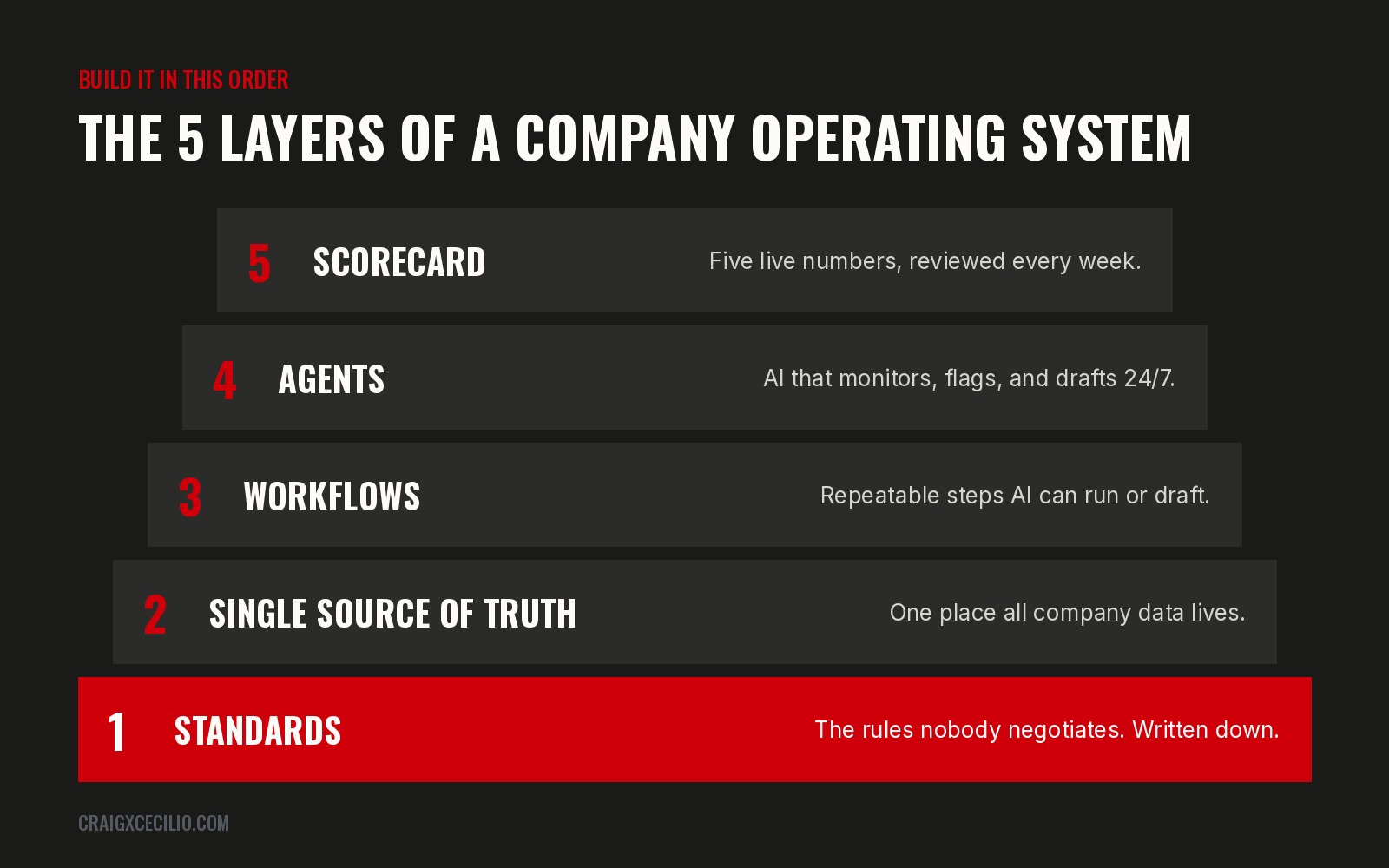
Layer 1: Write your standards down
If it isn't written, it isn't a standard. It's a mood.
My hiring standard is in writing: no side hustles and a two-year commitment. Nobody has to guess, and nobody gets a different answer depending on the day. AI can't follow a rule that only lives in your head, and neither can your team.

Layer 2: Build one source of truth
Every company I've reviewed has the same problem. The data exists, but it lives in ten places that don't talk to each other.
That's why I built Project High Tower, the one place where everything in my company connects. Sales, operations, content, and finance all point to the same hub. Without it, every AI tool you buy is guessing.
Layer 3: Turn recurring work into workflows
Open your calendar from last month. Anything you did more than twice is a workflow waiting to be written. Write the steps down, then decide which ones a machine can do.
My content runs this way now. One recorded conversation a week becomes a blog post, a newsletter, and a week of social posts. The workflow is written once and runs every week.
Layer 4: Add agents that watch, not just agents that talk
Most owners think AI means a chatbot. The bigger win is an agent that watches your own systems and tells you what it sees.
We're building one whose only job is to report what's slow, what broke overnight, and what the numbers say before a human notices. Think of it as the operator who never sleeps and never softens the news. It only works because layers one through three are already in place.
Layer 5: Keep score live
Pick five numbers, not fifty. Put them on one screen that updates on its own.
Then review them every week with the same questions. What moved? Why? What do we change? A scorecard you only look at on Friday is a history lesson, not a system.
Where owners trained the old way get stuck
I've watched smart operators stall on this. It's almost never about intelligence. It's about order.
- They start with the tool. They buy software first and look for a problem second.
- They automate a broken process. Now the broken process runs faster and nobody notices until it's expensive.
- They hand the whole thing to a vendor. Nobody can bolt AI onto your company from the outside. AI is an operating system, not an app, and the owner has to own it.
- They expect day-one results. An operating system compounds. The first month feels slow. Month six feels unfair.

My 90-day build order
This is the sequence I'd hand to any owner running a $5M to $50M company who wants to start Monday.
- Days 1 to 30: Write your top ten standards. Pick your single source of truth and start moving data into it.
- Days 31 to 60: Document your five most repeated workflows. Let AI draft or run the easiest two.
- Days 61 to 90: Launch one agent that watches one part of the business. Build the five-number scorecard and review it weekly.
That's it. No big launch. No consultant deck. Just layers, in order.
Quick Answers
What is a company operating system?
It's the written standards, connected data, repeatable workflows, and scorecard that run your business day to day. A good one works when the owner isn't in the room.
How do you build a company operating system with AI?
Build it in layers: standards first, then a single source of truth, then documented workflows, then AI agents, then a live scorecard. AI sits on top of the system. It can't replace it.
Do I need a technical team to do this?
You need someone who can connect your data, but the owner has to define the standards and workflows. The thinking can't be outsourced.
How long does it take to build?
You can have a working first version in about 90 days. It keeps improving every month after that.
Standards first. System second. Speed third.
-Craig
#RelentlessBuilder · #ProjectHighTower · #Operators · #TheCXCExperience