

The CTO Problem: What Nobody Tells You About Becoming a Tech Company
I ran businesses for 30 years. Then I built one that runs on code, and found out the rules I knew still apply. The skills I had didn't.
Craig Cecilio · The Relentless Builder
Here's a confession.
I've reviewed over 10,000 deals. I know a balance sheet in my sleep. I can look at a company for twenty minutes and tell you where it's going to break.
Then I started building an AI company, and for the first time in decades, I was the one who didn't know how the thing worked.
That's the CTO problem. Not the person. The gap.
The gap between owner and builder
A technology company has two languages. There's the language of business: cash, customers, risk, standards. And there's the language of the build: architecture, deployment, models, infrastructure.
Most founders are fluent in one. Almost nobody is fluent in both.
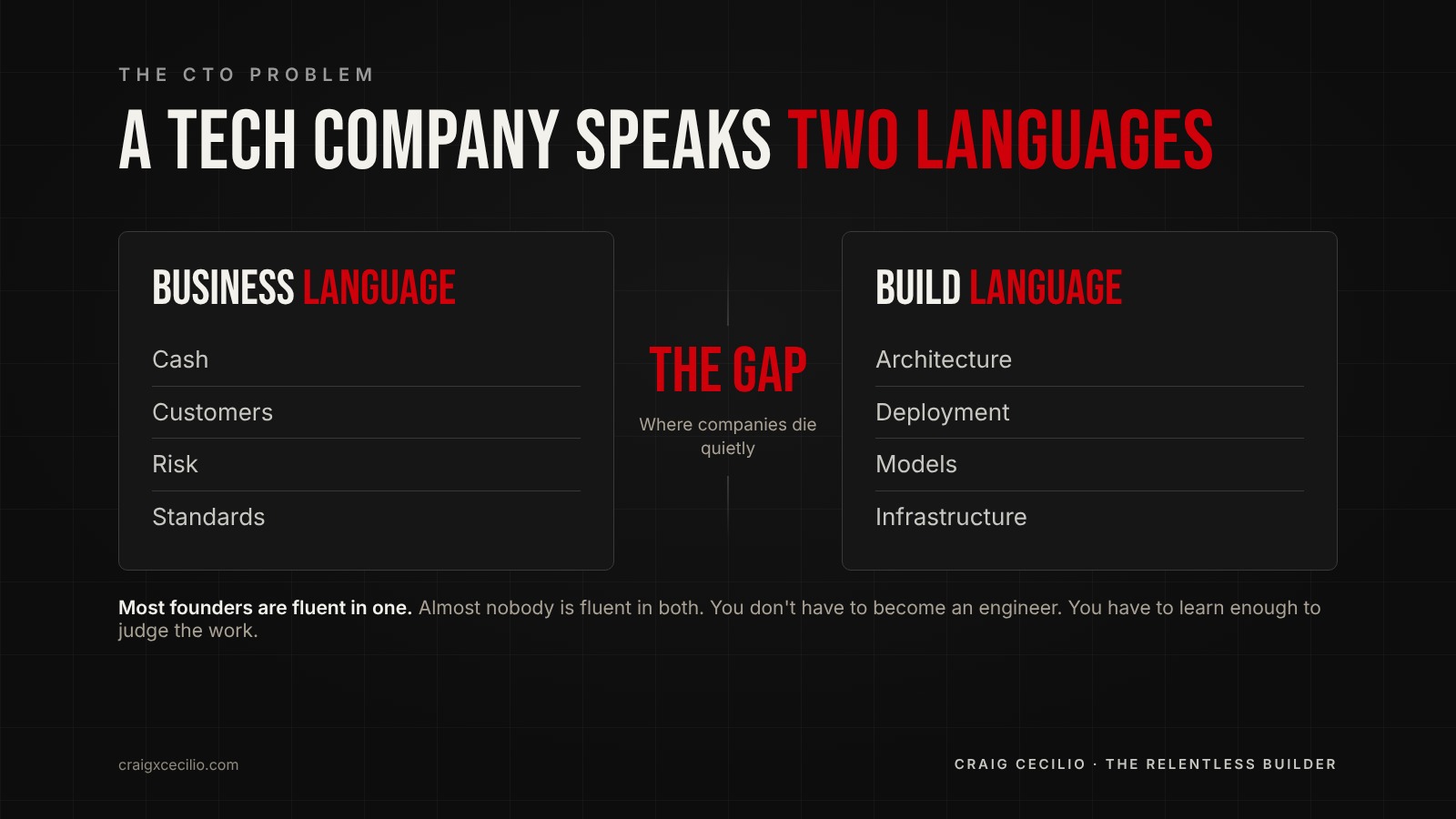
So you end up with a CTO who's never had to make payroll, and a CEO who can't tell a good sprint from a bad one. Each one is guessing at what the other does all day.
That gap is where companies die quietly.
What I had to rework with my cofounder
My cofounder and I sat down and went back to basics. Not AI basics. Business basics.
What are we selling? Who's the customer? What does a dollar of revenue cost us to earn? What happens if the biggest account leaves?
It sounds beneath a tech company. It isn't. The companies that skip this part are the ones with beautiful code and no business.

I've written before that AI makes a messy company move faster. The same is true of a messy strategy. A great engineering team will build exactly what you asked for, so you'd better know what you're asking for.
The skills I'm building at 50-plus
I'm not going to pretend I'm learning to code at a professional level. I'm learning enough to not be lied to.
- Enough architecture to ask why something takes three weeks instead of three days.
- Enough about deployment to know when "it's in staging" means it's done and when it means it's stuck.
- Enough about AI models to know which decisions are technical and which are just expensive.
The owners I know who are winning with technology aren't the ones who became engineers. They're the ones who refused to stay ignorant.
The seats I'm filling
The build has outgrown the founders. That's the goal, and it's also the problem.
Right now I'm hiring a Director of Operations and Deployment, the person who owns getting what we build into the hands of customers without drama. And I'm filling two VP of Engineering seats, which I wrote about this week.
Every one of those hires closes part of the gap. None of them closes it completely. That part is still on me.

The agent that watches everything
This is the part I'm most excited about, and the part most owners haven't thought about yet.
We're building an AI agent whose only job is to watch our own systems and tell us what it sees. Where things are slow. Where something broke overnight. What the data says we should look at before a human notices.
Think of it as the operator who never sleeps and never softens the news.

It only works because of Project High Tower, the single place where everything in my company connects. An agent can't give you feedback on what it can't see. Infrastructure first, intelligence second. Always.
What this means for you
You don't have to become a tech company to have the CTO problem. If you've hired anyone to build anything you don't fully understand, you've got a version of it.
- Learn enough to ask good questions. Not to do the job, to judge the job.
- Go back to business basics with whoever's building. Revenue, customer, cost, risk.
- Hire the seat that closes the biggest gap first, not the most impressive title.
- Build one place where the whole company is visible. Then let the machines watch it.
Quick Answers
What is the CTO problem?
It's the gap between the people who run the business and the people who build the technology. When neither side can judge the other's work, the company drifts.
Can a non-technical founder build a tech company?
Yes, but not by staying non-technical. You need enough fluency to evaluate decisions, hold a standard, and hire the right people to close the rest of the gap.
What should a founder learn first about their tech stack?
Architecture at a high level, how deployment works, and which AI decisions carry real cost. Enough to ask good questions and catch bad answers.
What is an AI agent for business operations?
Software that monitors your own systems and reports what it finds: slowdowns, failures, and patterns worth a human's attention. It needs a connected data foundation to be useful.
Learn the language. Close the gap. Build the machine.
-Craig
#RelentlessBuilder · #ProjectHighTower · #Operators · #TheCXCExperience