

Where Should AI Go First in Your Business? Start With Revenue
Every owner asks me where AI goes first. My answer is the same every time, and it isn't operations.
Craig Cecilio · The Relentless Builder
If you're asking where to start with AI in business, start with revenue. Put AI to work on whatever brings money in the door first. Operations will break when you do, and that's fine, because fixing it is the next step.
I said this on Raise the Bar with my friend Seth Bradley, and it's the question I get from every owner I talk to. They want a perfect plan before they touch anything. I get it, but owners don't have that luxury: you have to bring home the bacon, and the bacon comes from revenue.
Why revenue first
Revenue is the scoreboard. If AI doesn't help you win more business, keep more customers, or close faster, it's a science project.
Starting on the revenue side gives you something most AI projects never get: proof. A follow-up that goes out in minutes instead of days. A proposal drafted in an hour instead of a week. Numbers you can show your team on Monday.
Proof buys you the patience to do the harder work later.
Then operations breaks. It always does.
Here's what happens next. Revenue picks up, and the back office can't keep up.
More leads mean more onboarding. More deals mean more contracts, more invoices, more handoffs. The cracks you could ignore at the old pace show up fast.
That's not failure. That's the signal. Now you go fix operations, then you go back to revenue.
Back and forth. That's the job.
Most owners think AI is a one-time install. It isn't. It's a loop.
- Revenue: add AI where it helps you sell, follow up, or keep customers.
- Operations: fix what breaks under the new volume.
- Repeat: go back to revenue with a stronger foundation.
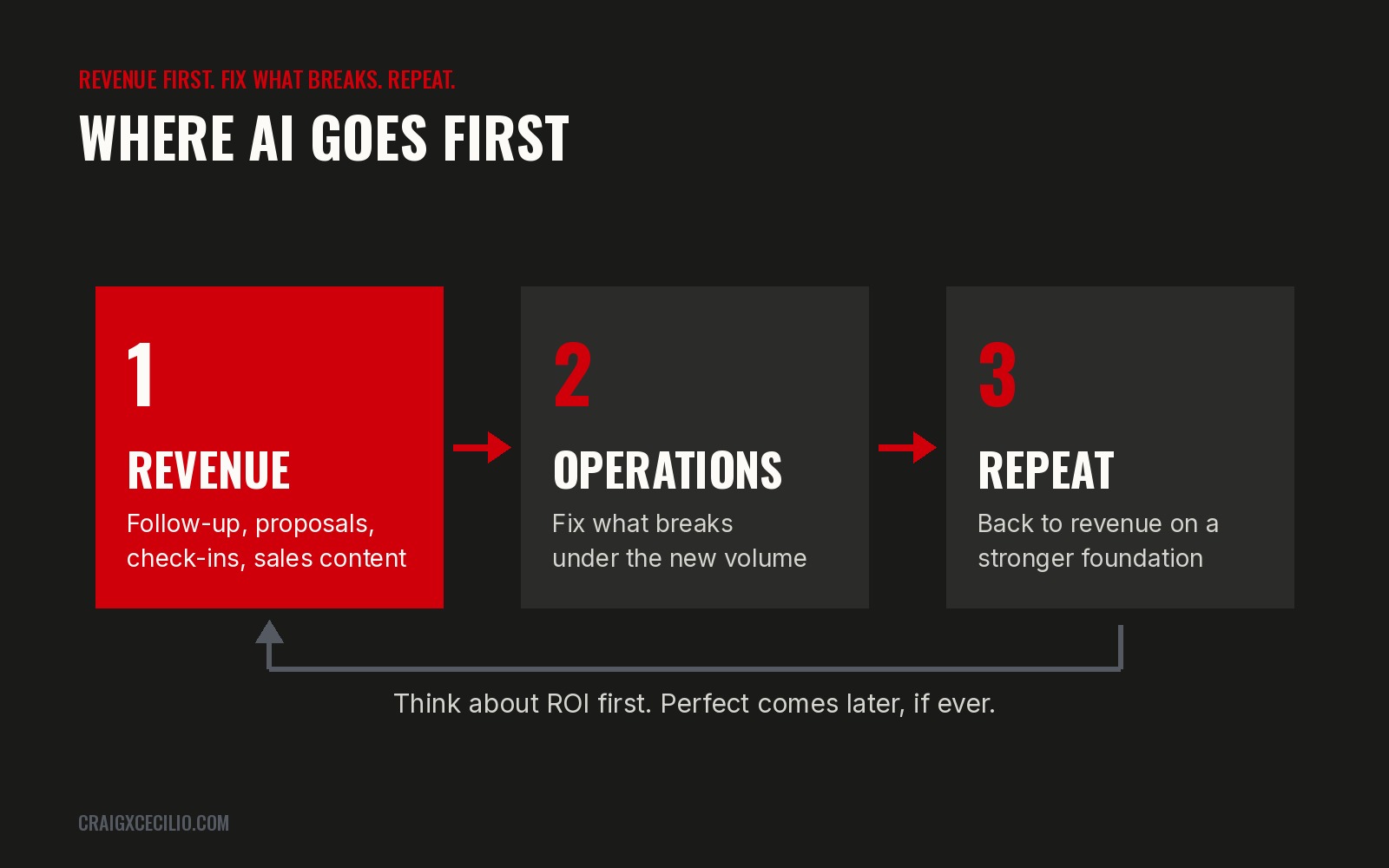
Every lap makes the company faster and the foundation stronger. I wrote about the foundation side in how to build a company operating system with AI.
Techies want perfect. Owners need ROI.
A lot of technical people want to build the perfect process before anything ships. Every edge case handled. Every workflow mapped.
I respect that. But perfect is expensive, and it's slow. While you're mapping, your competitor is closing.
Think about ROI first. Perfect comes later, if ever.
Where to put AI on the revenue side first
You don't need a big project to start. Pick the one place where speed or follow-through costs you money today.
- Lead follow-up. The first business to respond usually wins the conversation. AI can draft the reply while you're still in your last meeting.
- Proposals and quotes. Turn your best past proposals into a template AI can fill from a call summary.
- Customer check-ins. A short, personal note to every customer every quarter. Most companies never do it because nobody has the time.
- Sales content. One recorded conversation becomes a week of posts, a newsletter, and a blog. That's how my own content runs now.
Pick one. Measure it for 30 days. Then decide what's next.

How to know operations is breaking
You'll feel it before you see it in the numbers. Watch for these:
- Customers asking the same question twice because nobody answered the first time.
- Your team rebuilding the same spreadsheet every week.
- Deals closed but not onboarded for days.
- You becoming the bottleneck again.
When you see two of those, stop adding on the revenue side and go fix the operation underneath it.
Quick Answers
Where should AI go first in a business?
Start with revenue: lead follow-up, proposals, customer check-ins, or sales content. It gives you proof of ROI fast, which funds the harder operational work.
Should I fix operations before using AI?
Fix what's broken enough to stop you from serving customers, then start on revenue. Operations will break again as volume grows, and that's when you go back and strengthen it.
Why do AI projects fail in small and mid-size companies?
Most try to build the perfect system before proving any return. Owners lose patience, the project stalls, and nothing ships.
How long before AI shows a return?
A focused revenue use case can show results in 30 days. Building it across the whole company takes longer, one lap at a time.
Revenue first. Fix what breaks. Go again.
-Craig
#RelentlessBuilder · #AI · #Operators · #RaiseTheBar · #TheCXCExperience