
The Three Ceilings: What Breaks at $5M, $20M, and $50M
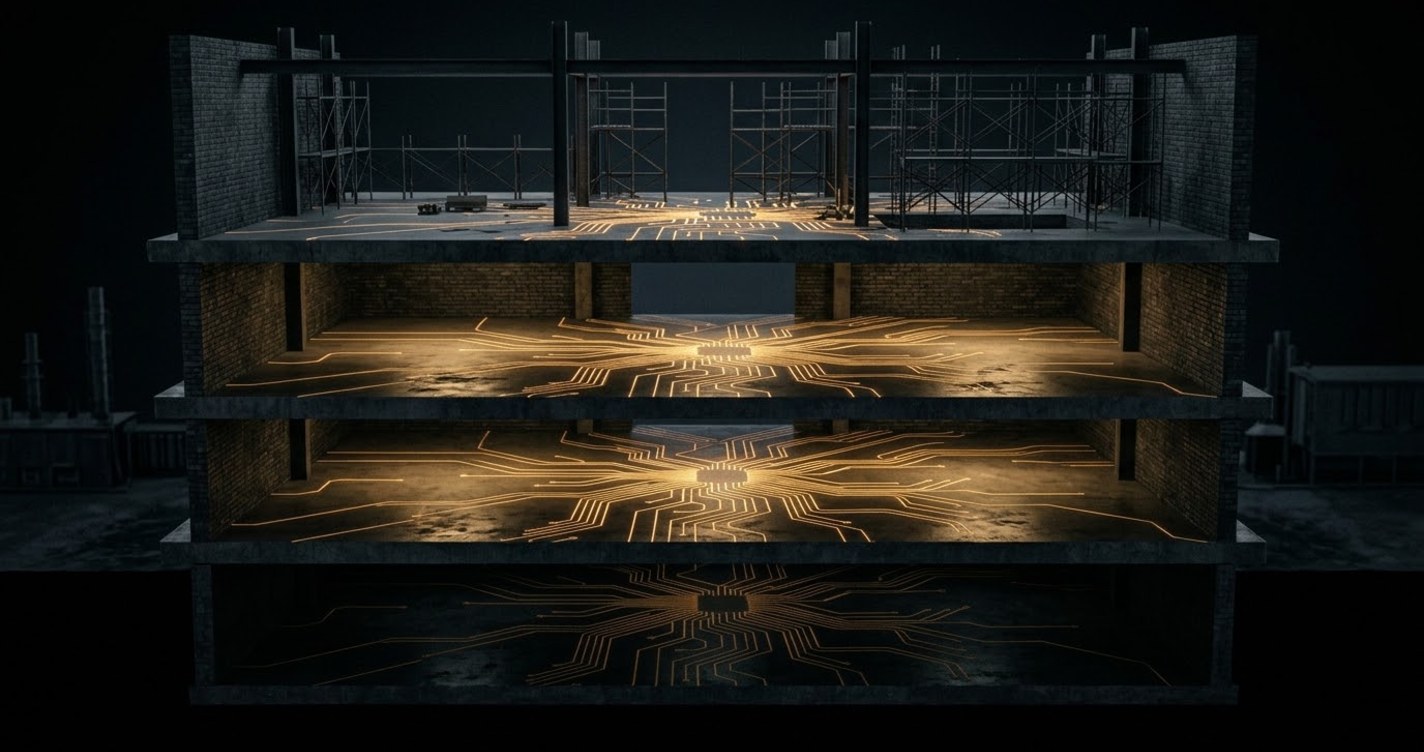
Every company that grows hits the same three ceilings. The owners who break through don't work harder. They build the next floor before they need it.
Craig Cecilio · The Relentless Builder
Every company I've watched grow hits the same walls.
Different industries. Different founders. Same three ceilings, almost to the dollar.
The ones who break through aren't the ones who work the hardest. They're the ones who see the ceiling coming and build the next floor before they hit it.
First, what scaling actually means
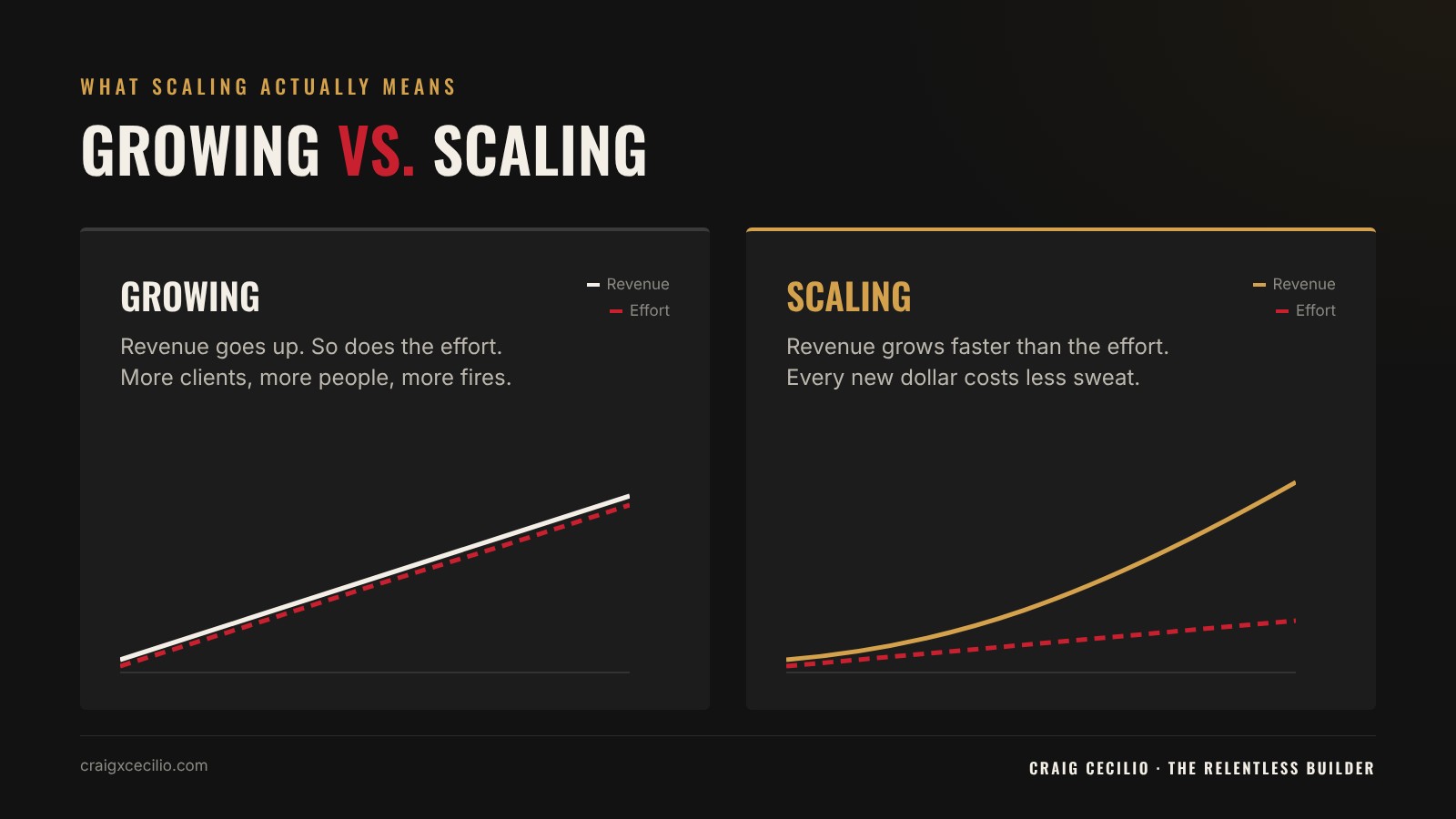
Growing means revenue goes up and so does the effort. More clients, more people, more hours, more fires.
Scaling means revenue goes up faster than the effort does.
That's the whole game. If every new dollar costs you the same amount of sweat as the last one, you're not scaling. You're just getting bigger and more tired.
Ceiling one: $5M. You are the system.
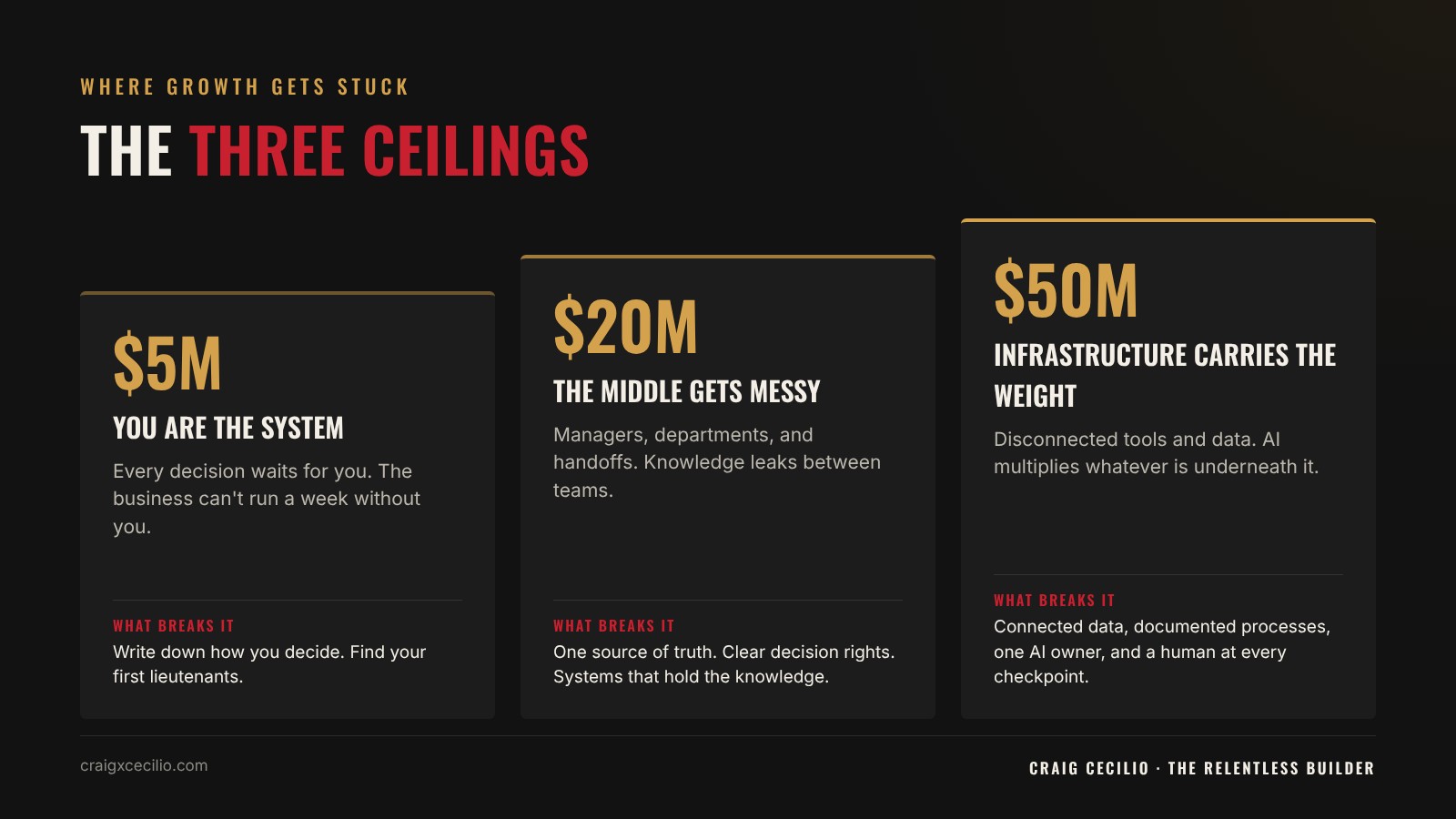
At $5M, the company runs through you. Every client knows your cell number. Every big decision waits for you. You know where every dollar is because you touched it.
That works until it doesn't. Then you look up and realize the business can't run a week without you.
What breaks it: Writing down how you make decisions, and finding your first lieutenants. People who can carry part of the mission without you in the room.
Ceiling two: $20M. The middle gets messy.
Now you have managers. Departments. Handoffs.
And this is where the knowledge starts to leak. Sales doesn't know what operations promised. Finance finds out last. The way things really get done lives in five people's heads, and two of them are thinking about leaving.
What breaks it: One source of truth for customers, money, and operations. Clear decision rights: who decides what, and who gets told. Systems that hold the knowledge so people don't have to.
Ceiling three: $50M. The infrastructure has to carry the weight.
At $50M, you're not running a company anymore. You're running a machine made of people, data, and tools.
Tools that don't talk to each other. Data in a dozen places. Projects nobody owns. This is also where AI either becomes your biggest advantage or your most expensive mess, because AI multiplies whatever's underneath it. Good systems get faster. Broken ones break faster.
What breaks it: Infrastructure first. Connected data, documented processes, one leader who owns AI across the company, and a human at every checkpoint.
The pattern behind all three
Look at those three ceilings again. None of them are about effort.
They're about what the company can carry without you.
At every stage, the owner's instinct is to push harder. That's what got you here. But the next level never comes from more hours. It comes from building the floor that holds the weight.
Quick Answers
What does it mean to scale a business?
Scaling means revenue grows faster than the effort, cost, and people it takes to produce it. Growth adds work. Scaling adds leverage.
What are the biggest challenges when scaling a business?
The owner becoming the bottleneck, knowledge stuck in people's heads, disconnected systems, and unclear ownership. They show up at predictable stages, usually around $5M, $20M, and $50M.
How do you scale a business without burning out?
Stop being the system. Write down how you decide, build a team of people who can carry the weight, and invest in systems before the growth forces you to.
Where does AI fit when scaling a company?
AI is most powerful at the third ceiling, but only on top of clean data, documented processes, and clear ownership. It multiplies whatever is underneath it.
Know your ceiling. Then build the floor above it.
-Craig
#RelentlessBuilder · #TheCXCExperience · #Scaling