

The Hidden Costs of AI: Is It Making You Money or Just Busier?
AI is only worth it if it produces an outcome. Craig Cecilio's 4-question test for owners: is revenue up, are costs down, are hours down, are headaches down?
Craig Cecilio · The Relentless Builder
The hidden costs of AI for business don't show up on the invoice. They show up in longer days, bigger token bills, and teams that look busier but aren't producing more. If AI isn't moving revenue or cutting costs, it's costing you.
Everybody's selling AI right now, AI to do this and AI to do that, and I'm building on those tools every day myself. But as an owner carrying real payroll, I only care about one question: can AI produce an outcome for us? That's the question most owners I know are losing sleep over, and it's the one the hype never answers.
Activity is not an outcome
Here's a confession. I sat down with one of my top people a while back. He'd built some great technology, genuinely impressive work.
But when we talked it through, we weren't aligned on the outcome. The tech was great. The business result wasn't there yet.
That's the trap. It's easy to fall in love with what AI can do and forget to ask what it did.
No matter what technology we use, especially AI, we have to be outcome based.
The 4-question AI outcome test
So I went back and rebuilt the culture around one rule. Every AI project answers four questions, every month.
- Is revenue going up? More deals, faster closes, more customers kept.
- Are costs going down? Something you paid for before that you don't pay for now.
- Are hours going down? Real time back, not just different work.
- Are headaches going down? Fewer fires, fewer handoffs, fewer "who owns this?" moments.
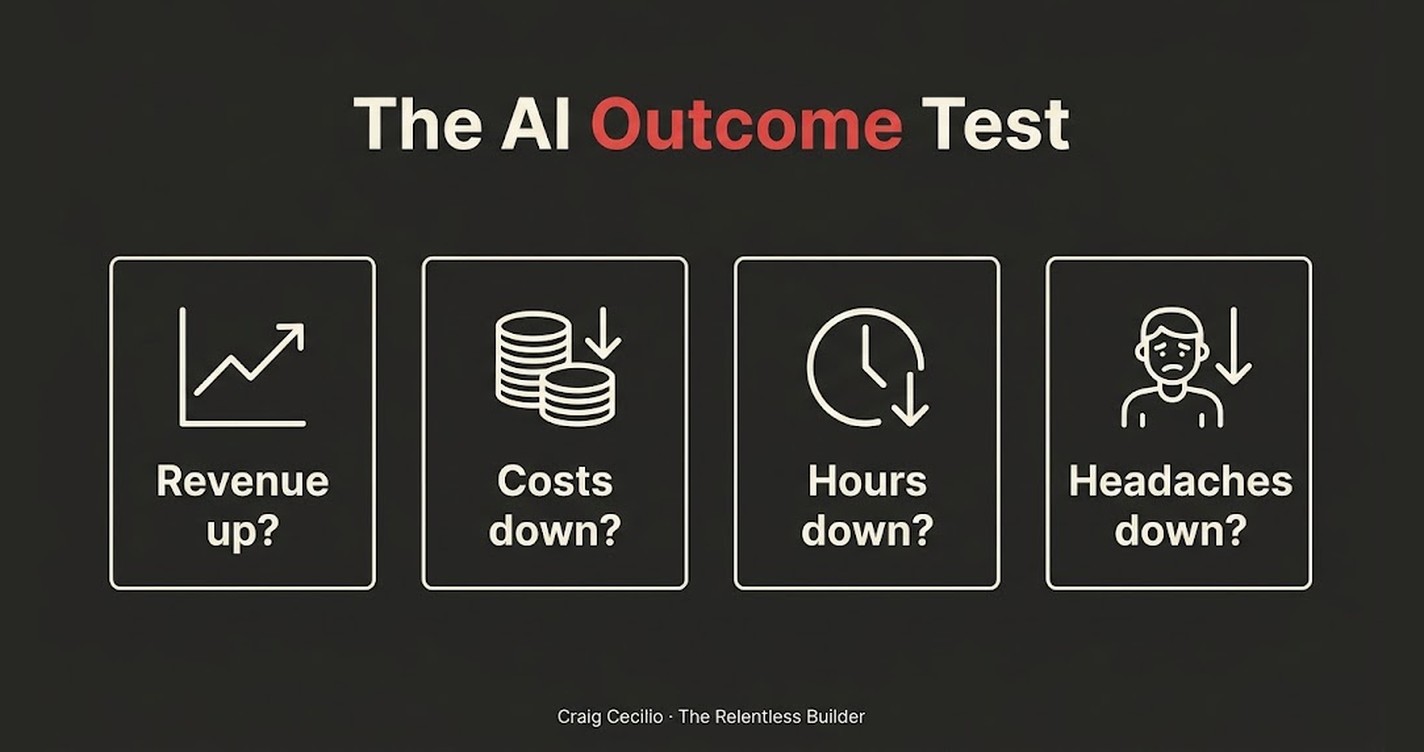
If the answer is no on all four, it's not an investment. It's a hobby.

The hidden costs nobody budgets for
Most owners budget for the software. Almost nobody budgets for what comes with it.
- The 10-hour day that turns into 12. If your team is working longer to babysit the tools, you've added cost, not removed it.
- Token bills on the balance sheet. Every AI call costs money. Run enough of them and it becomes a real line item.
- Rework. AI output that has to be checked, fixed, and redone isn't free just because it was fast.
- Distraction. Every hour spent playing with a new tool is an hour not spent selling.
None of these mean stop. They mean watch. Put the hours and the token spend next to the revenue and cost numbers, and look at them together.
Efficiency is the whole point
In real estate, they call it CapEx. You put money into the building because it makes the building worth more. In a technology department, it's the same idea.
So ask it plainly. Is this making me more efficient? If you're spending more hours, more money, and more attention, and revenue isn't going up or costs aren't coming down, where are the savings?
I wrote about where AI should go first: start with revenue, prove it, then fix what breaks. This is the other half. Once it's running, make it keep earning its seat.

How I retrained my team to be outcome based
Changing the tools was easy. Changing the habits took work. Here's what we do now.
- Name the outcome first. Before anyone builds anything, we write down which of the four questions it answers.
- Pick one number. Revenue, cost, hours, or headaches. One number we'll check in 30 days.
- Track the hidden costs. Hours spent and token spend go on the same page as the result.
- Kill or keep. If the number didn't move, we change the approach or we stop. No doubling down out of pride.
It's the same discipline I use in my company operating system. Standards first, then the system, then the speed.
Share your story
These are the questions we all have right now: how are you using AI today, and is it paying for itself? What are you doing about the projects that aren't?
I'll keep sharing real examples from my own companies, including the ones that didn't work. I want to hear yours too.

Takeaways
- Run every AI project through four questions. Is revenue up, are costs down, are hours down, and are headaches down?
- Budget for the costs that don't show on the invoice. Longer days, token bills, rework, and distraction are all real money.
- Kill or keep in 30 days. If the number didn't move, change the approach or stop. Busy is not a result.
Quick Answers
What are the hidden costs of AI for a business?
Longer workdays spent managing tools, growing token or usage bills, rework on AI output that has to be fixed, and time pulled away from selling. They rarely show up on the software invoice.
How do I know if AI is working in my business?
Run four questions every month: is revenue going up, are costs going down, are hours going down, and are headaches going down? If none of them moved, the project needs a new approach.
How much do AI tokens cost a business?
It depends on the tools and volume, but heavy daily use adds up to a real monthly line item. Track it next to the results so you can see whether it pays for itself.
Is AI worth it for a small or mid-size business?
Yes, when it's tied to a business outcome. AI used without a clear revenue, cost, or time goal usually adds work instead of removing it.
Outcome first. Tools second. Busy is not a result.
-Craig