

The AI R&D Line Item: Can Your Business Afford to Experiment?
Learning AI is an expense, and that's fine if you name it. Craig Cecilio on splitting AI spend into a capped R&D line and an operating line that has to earn its keep.
Craig Cecilio · The Relentless Builder
Your AI budget for small business needs two lines, not one: R&D, which is capped money you spend to learn, and operating investment, which has to raise revenue or cut costs. Mixing the two is how owners quietly bleed cash.
Big tech companies run full-time research and development departments where people get paid to play with new tools all day. A company doing $5M to $50M doesn't have that luxury, because every hour comes out of the same pot that makes payroll. So you have to decide, on purpose, how much playing you can afford, and then hold the line on it.
Big companies pay people to play. You can't.
The engineers inside the big AI companies get to experiment for a living. They try things, break things, and nobody asks for the return next quarter.
Most of us aren't built like that. Every hour and every dollar comes out of the same pot that makes payroll.
That doesn't mean you shouldn't experiment. It means you should know when you are.

Two buckets: learning vs. operating
Here's how I split it in my own companies.
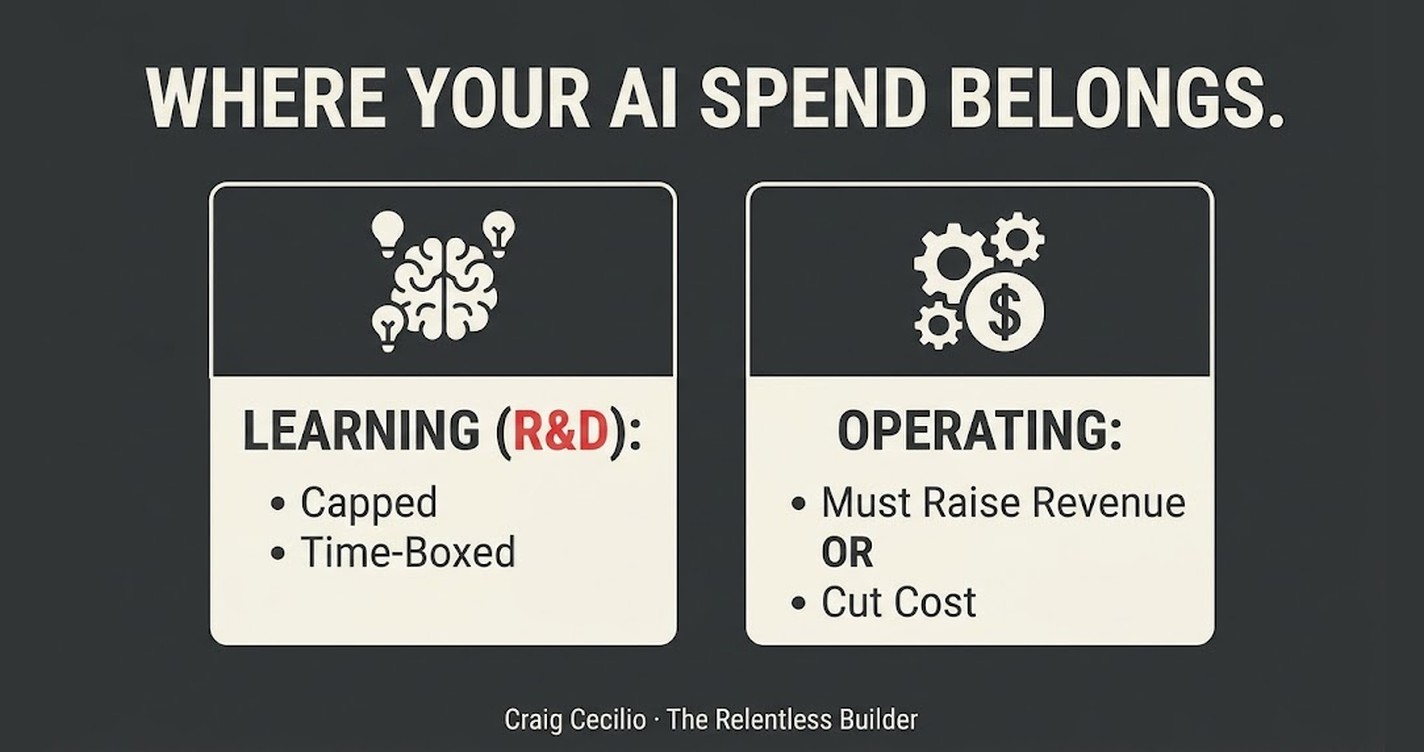
- Learning (R&D). Money and time spent figuring out what AI can do for us. It's an expense, capped, with an end date.
- Operating (investment). AI that's already proven and running in the business, which has to raise revenue, cut costs, or give hours back. If it doesn't, it gets cut.
The mistake is letting learning money pretend to be operating money. You tell yourself it's an investment, so you never stop. Six months later you've got a big bill and nothing that runs on its own.
Put AI on the R&D line, on purpose
If you're going to learn, line-item it. Write it down as R&D so everyone knows what it is.
- Set a cap. A fixed monthly amount for tools, tokens, and outside help.
- Set a time box. 60 or 90 days for each experiment.
- Set the question. What are we trying to learn, and what would make us move it to the operating line?
- Review it monthly. Keep, move, or kill.
Learning is worth paying for, and I've written that it takes a thousand reps to learn AI. Those reps cost something, so budget for them instead of pretending they're free.

The CapEx mindset: when an experiment has to earn its keep
In real estate, you put money into a property because it makes the property worth more. That's CapEx. The money has a job.
AI on the operating line needs the same job description. Once an experiment works, it moves over, and from then on it's judged like any other investment. Is it making us more efficient, and can we see it in the numbers?
I start that work on the revenue side, which I explained in where AI should go first. Revenue gives you the proof that funds everything else.
Can you afford it today?
Ask yourself honestly. If the R&D line went to zero tomorrow, would the business feel it? If not, it might be too big.
And ask the other side too. If you spend nothing on learning, how far behind will you be in two years? For most owners, the answer is a small, capped R&D line, watched every month.

What I'm tracking in my own business
- Monthly spend on AI tools and tokens, split by learning and operating.
- Hours spent on experiments vs. hours saved by what's running.
- Which experiments graduated to the operating line, and which got cut.
It's not fancy. It's just honest. And honest numbers are the only way to know whether you're investing or just spending.
Takeaways
- Give AI two budget lines. Learning money is capped and time-boxed. Operating money has to raise revenue, cut costs, or give hours back.
- Review the R&D line every month. Every experiment gets one of three calls: keep it, move it to operating, or kill it.
- Track what you spend next to what you save. Honest numbers tell you whether you're investing or just spending.
Quick Answers
How much should a small business spend on AI?
Start with a small, fixed monthly R&D cap for learning and experiments, then fund proven tools from the operating budget based on the revenue, cost, or time they return.
Is AI spending CapEx or OpEx?
Most AI subscriptions and token usage are operating expenses. The CapEx mindset still helps: treat proven AI like an investment that has to raise the value of the business.
What is an AI R&D budget?
A capped, time-boxed amount set aside to learn and test AI tools. It's tracked separately so experiments don't quietly become permanent costs.
When should you cut an AI experiment?
When its time box ends without moving a clear number: revenue, costs, hours, or headaches. Change the approach or stop.
Name it. Cap it. Make it earn its keep.
-Craig